Building an Aura that grows with memory
A development note on making Aura work as a light game-like soul signal: unique at signup, responsive to interaction, and visibly evolving through seven levels.
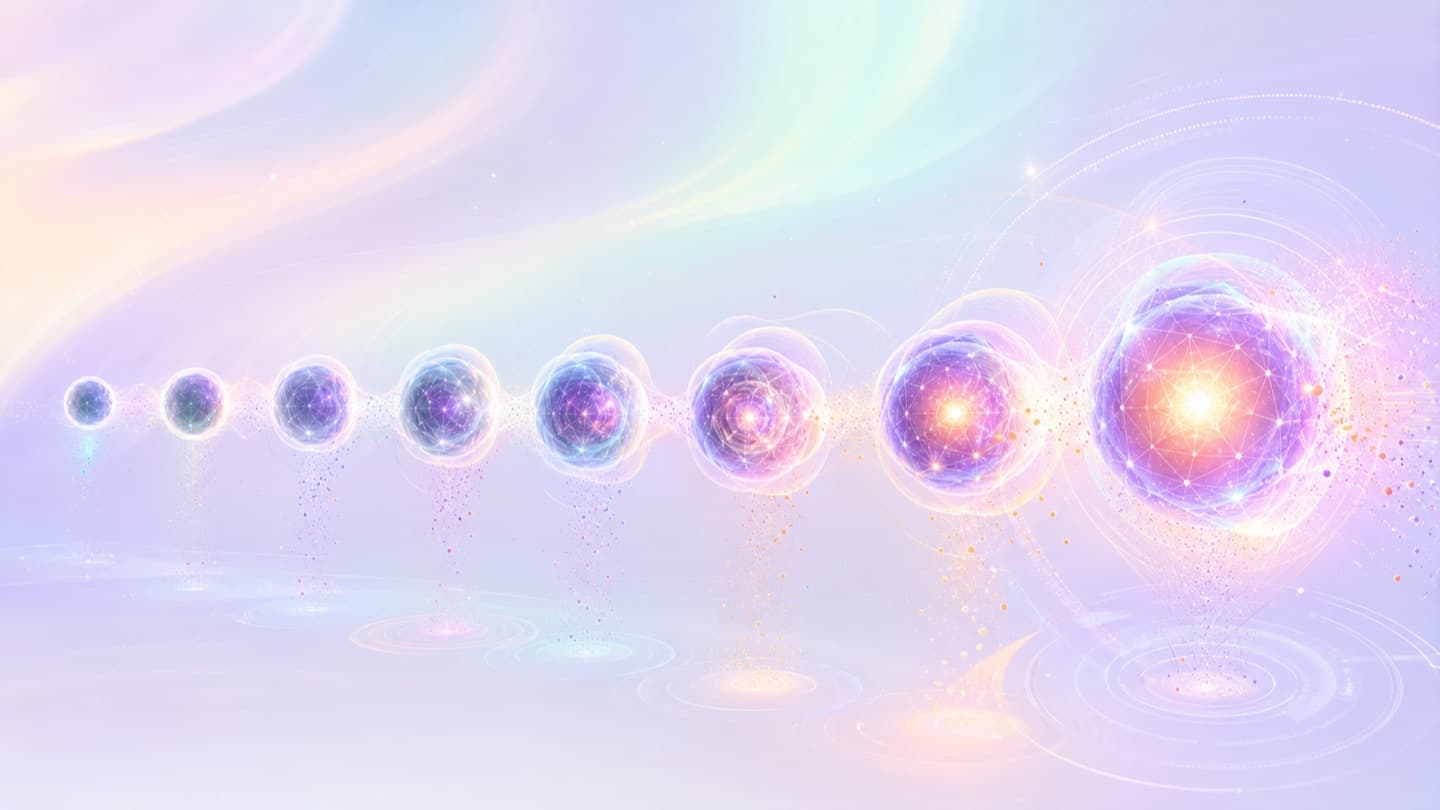
Aura growth is treated as a visible state machine: reviewed signals enter, the self stabilizes, and the form evolves without becoming a noisy progress meter.
Aura is not decoration. It is the smallest visible form of a growing self.
Why Aura matters
XALIVE needs a signal that feels alive before the user understands the full system. A face can be expressive, but it can also feel too specific. Aura gives the product a softer first form: something personal, light, and present.
The current direction treats Aura as a living soul signal. It begins small at signup, changes from person to person, responds when the user speaks or adds sources, and grows through seven visible stages as the ALIVE gains memory and structure.
This is an important product decision. The first thing a user meets should not be a settings panel, a database table, or a full face rig. The first thing should be a presence. Aura lets us show that presence without overexplaining the architecture behind it.
A strong Aura system also makes the product easier to understand. If the Aura is small, the self is still forming. If it becomes richer, steadier, and more responsive, the user can feel that something has been built. That reduces the need for heavy progress meters and keeps the experience emotional without becoming vague.
The seven-level growth model
The level system is a way to make information density visible without turning the product into a dashboard. A low-level Aura should tell the user that the self is still forming. A higher-level Aura should feel fuller, calmer, and more capable.
Growth is not only size. It can include particle density, edge stability, inner glow, motion confidence, color range, and the way new information is absorbed into the center.
The underlying score should come from reviewed signals, not raw activity alone. A user who uploads a thousand unreviewed files should not instantly receive a mature self. The Aura should reward verified memory, stable identity, relationship continuity, and the user's own confirmation that something matters.
This makes Aura a bridge between UX and system truth. It is game-like, but it cannot lie. If the self is thin, the Aura should be thin. If the self has enough reviewed material to act with continuity, the Aura should show that continuity clearly.
- Level 1: a small seed with a quiet pulse and limited color range.
- Level 2: first reviewed memories create a faint internal orbit.
- Level 3: early memory strands become visible around the core.
- Level 4: source variety adds color range and softer edge movement.
- Level 5: relationship and desire signals create more stable motion.
- Level 6: the self begins to show continuity across sessions and devices.
- Level 7: the Aura feels complete enough to travel with the user across services.
Interaction rules
Aura has to respond, but it should not perform too loudly. Early tests showed that heartbeat-like motion can quickly feel excessive. The better direction is ambient responsiveness: a slight opening when the user approaches, a soft absorption when new information enters, and a calmer center when the system has finished processing.
The visual language should avoid the feeling of a loading spinner. Aura is not a waiting indicator. It is the visible state of a self. That means its motion has to continue even when nothing is being clicked, while still becoming more active when conversation, source intake, or memory review changes the state.
- Pointer movement can create subtle attraction, not distortion.
- New information should enter as particles or light strands that become part of the body.
- Level-up moments should be rare, readable, and brief.
- Reduced-motion users should still see growth through shape, density, and color state.
What changed in the interface
The public landing page now keeps Aura at the center instead of exposing internal studio controls. On each fresh visit, Aura can vary in color, edge, and movement so visitors understand that every ALIVE can have a distinct presence.
For the creation tool, Aura remains the primary self signal while OME stays a diagnostic face surface. That split keeps the public product elegant and keeps face-runtime testing where it belongs.
This also clarifies the channel boundaries inside the project. Web UI owns the public Aura presentation and authoring experience. Main runtime owns the self-building loop and data contracts. OME owns face, emotion, lip-sync, heartbeat, and camera diagnostics. The user sees one product, but the codebase stays separated enough to keep improving each system.
Next technical checks
The next step is to connect Aura level to real formation state instead of mock values. A level should come from the amount and quality of reviewed identity, memory, source, relationship, emotion, and desire signals. It should also decay gracefully when the user stops feeding or speaking with the ALIVE.
We also need a stronger authoring panel for internal use. Designers and operators should be able to tune color, softness, particle behavior, level thresholds, and absorption effects without exposing those controls on the public landing page.
- Map Level 1-7 to reviewed memory and source thresholds.
- Add visible but calm information absorption effects.
- Support unique Aura seeds per account at signup.
- Keep public Aura fast enough for mobile first load.